Minnesota Minimum Wage Calculator
Minnesota’s statewide minimum rises from $11.41 to $11.87 an hour on January 1, 2027, the inflation adjustment DLI published for all employers (checked October 15, 2026). Through December 31 the state minimum is $11.41 per hour. Minneapolis and covered Saint Paul workplaces have higher local rates. Tips must be paid in addition to the applicable wage. Choose the workplace rule and confirm whether federal 40-hour or Minnesota-only 48-hour overtime applies.
Time card Calculate pay for a covered hourly job
Weekly gross including tips—
Confirm coverage to calculate.
- Hourly floor—
- Per workday—
- Weekly gross—
- Monthly average—
- Yearly gross—
- Employer cash before shortfall
- —
- Weekly tips retained
- —
- Employer shortfall payment
- —
- Total employer cash
- —
Overtime uses the full regular rate before subtracting a permitted tip credit. Retained voluntary tips are additional to the full cash wage. This floor scenario does not calculate pay at a higher agreed rate. Per-workday pay divides the week by the days with hours. Annual figures repeat the rounded weekly result.
Reviewed rate period: 2026-01-01 through 2027-12-31. Gross earnings before taxes or deductions. Annual figures repeat this weekly scenario; they do not combine different rate periods.
Reviewed October 2, 2026. Minnesota DLI minimum wage; DLI overtime FAQ.
Published 2027 state and Saint Paul rates
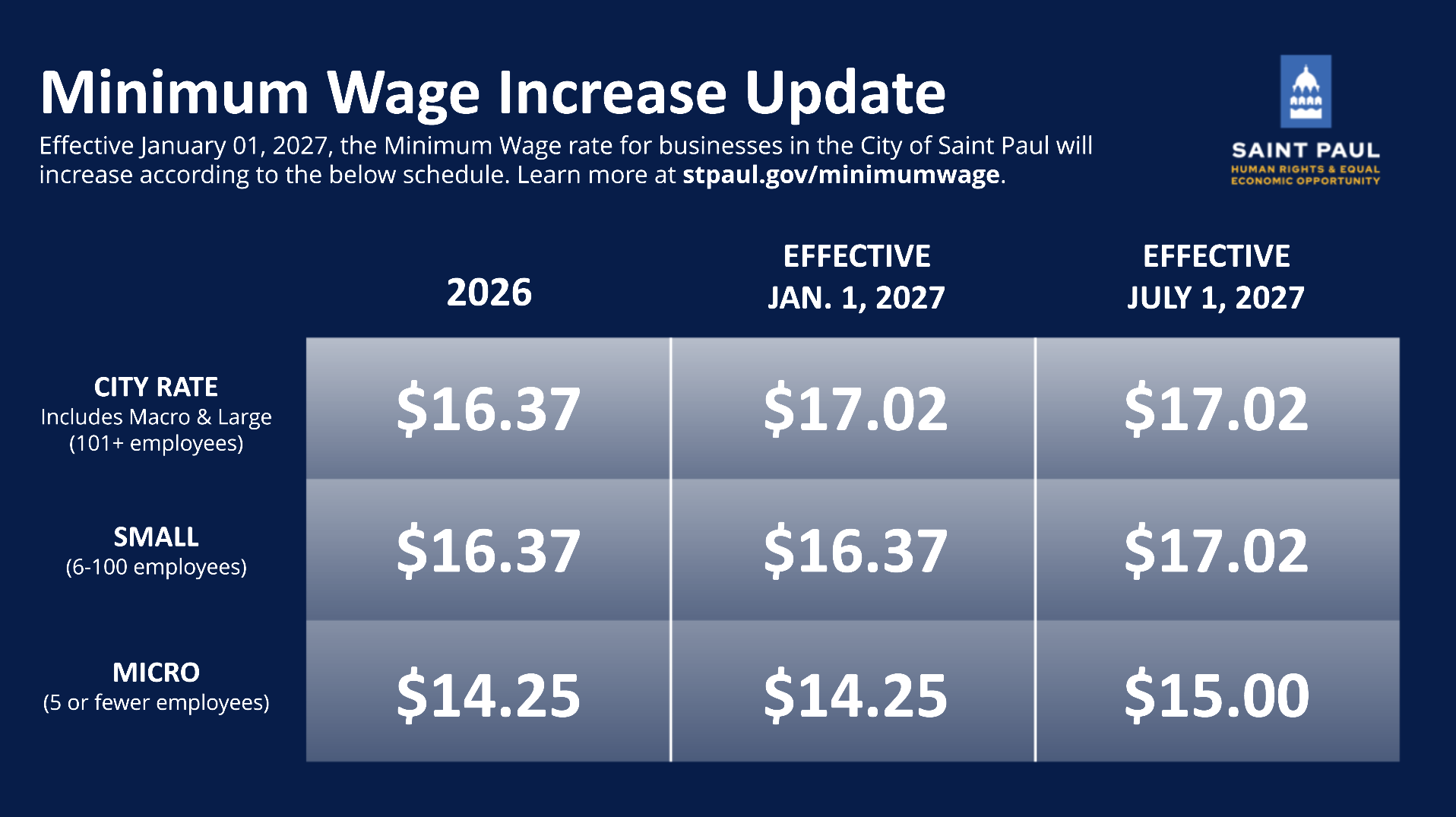
Minnesota DLI sets the statewide floor at $11.87 from January 1, 2027. The Saint Paul 2027 chart sets the city rate for employers with 101 or more employees at $17.02 from January 1. Employers with 6–100 employees keep $16.37 through June, then use $17.02 from July 1. Employers with five or fewer keep $14.25 through June, then use $15.00. These distinct dates are applied by the form. Minneapolis’s labor standards page sets the city rate at $17.02 for all business sizes from January 1, 2027 (checked October 5, 2026), so a Minneapolis week of 40 hours rises from $654.80 to $680.80.
2026 city and state rates
| Covered ordinary workplace | January–June | July–December |
|---|---|---|
| State floor | $11.41 | $11.41 |
| Minneapolis, all sizes | $16.37 | $16.37 |
| Saint Paul, 101+ employees | $16.37 | $16.37 |
| Saint Paul, 6–100 employees | $15.00 | $16.37 |
| Saint Paul, 5 or fewer employees | $13.25 | $14.25 |
Minneapolis’s 2026 increase applies to all business sizes. Saint Paul’s small and micro categories change on July 1, so using one statewide rate would miss both geography and date. Minneapolis announcement; Saint Paul 2026 announcement; Saint Paul dated schedule.
Forty or forty-eight hours is a coverage question
DLI says Minnesota law generally requires overtime after 48 hours in a seven-day workweek, while the federal FLSA requires it after 40 for covered nonexempt work. The 48-hour option requires confirmation that federal overtime does not apply. Employer size alone is insufficient to decide an individual worker’s federal protection. DLI wage-and-overtime FAQ; Federal coverage guidance.
For 45 hours at the state floor, federal coverage produces $541.98 after rounding, while a confirmed state-only case produces $513.45. At 50 hours, the results are $627.55 and $581.91 respectively. Those differences come from the overtime threshold; choosing the smaller result does not establish that it is legally available.
Saint Paul business size counts more than today’s shift
The city generally uses the prior year’s average weekly employee count, including full-time, part-time, joint and temporary employees. New employers use a first-13-week calculation. Franchise and integrated-enterprise rules can combine employees across locations; a limited rule for certain full-service restaurants differs. Confirm the city category before selecting micro, small or 101+ rather than counting only people at one location on one day. City business-size guidance.
For a confirmed six-employee Saint Paul business, a 40-hour week changes from $600 before July to $654.80 after July. For a confirmed five-employee micro business, it changes from $530 to $570. A week straddling the rate change needs a calculation using the actual dated hours; this form assumes one rate throughout the week.
There is no lower cash wage for a tipped worker
Minnesota prohibits using tips as a credit toward minimum wage. For 40 Minneapolis hours at $16.37 with $200 retained tips, the employer pays $654.80 and gross including tips is $854.80. The tool never reduces that employer payment because tips were high. DLI tip-credit prohibition.
DLI also states that card or electronic-payment tips must be passed through in full, with no card-fee deduction, under the rule effective August 1, 2024. Its guidance describes restrictions and limited exceptions for tip sharing. Record tips retained separately from the cash wage; an employer-directed pool should not be presumed lawful. Tip retention and electronic-payment guidance.
Convert the actual work schedule to annual gross
A repeated 40-hour, 52-week state-floor schedule yields $23,732.80. The Minneapolis schedule yields $34,049.60 before tips and taxes. Saint Paul’s midyear changes mean a whole-year total must combine the appropriate periods instead of repeating December’s rate backward across January.
The ordinary adult model excludes training rates, special certificates, agriculture, special hospital/residential work periods and contract wages. Only hours actually worked count toward the displayed overtime; paid leave is not entered as work time.
Neighboring workplaces: Wisconsin minimum wage, Iowa minimum wage, North Dakota minimum wage and South Dakota minimum wage. Methodology · Sources.
Updated First published